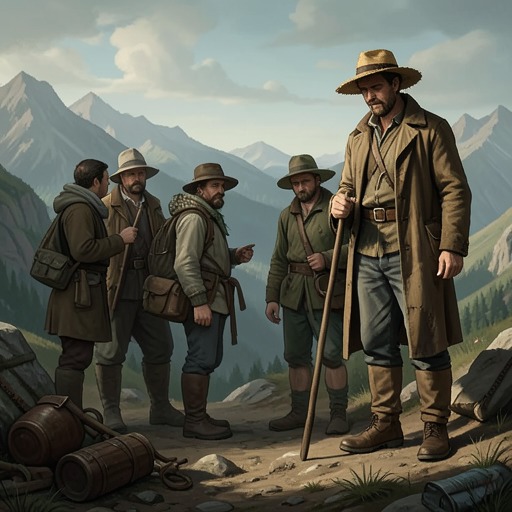
Hans and Professor Hardwigg
A Journey to the Centre of the EarthHans and Professor Hardwigg are bound by a durable hierarchy of service and trust: Hans obeys the Professor with remarkable composure, and the Professor treats him as a dependable companion whose judgment and labor can be relied upon. Their relationship becomes clearest under pressure, when Harry tries to turn Hans against the expedition and fails, and later when Hans’s work after the storm saves much of the party’s equipment. The bond is not presented as negotiation between equals; its strength lies in Hans’s chosen-seeming fidelity and the Professor’s confidence that he will remain at his side.
A relationship organized around command
Hans’s place beside the Professor is established through action rather than explanation. When the party faces a life-or-death choice about whether to return to the crater or continue into the earth, Hans waits calmly for the signal that will tell him which way to go. He understands the seriousness of the disagreement between Harry and the Professor, but does not intervene in it. The immediate decision belongs to the Professor, and Hans is prepared to carry out whichever order he gives.
That division of authority becomes explicit when Harry catches Hans by the hand and points toward the route back to the summit. Hans remains still, then gently shakes his head and points to the Professor. His single word, “Master,” names the relationship in its simplest form: Harry’s urgency does not supersede Hans’s allegiance. The gesture is more decisive than a debate could be. Hans does not answer Harry’s plea with an argument about danger; he identifies the person whose direction governs his actions.
The scene also shows the limits of communication between the three men. Harry believes he might persuade Hans if he could make him understand the dangers as he understands them, but Hans’s calm does not change. When Harry tries to force him up, the Professor intervenes and tells his nephew that he will gain nothing from his devoted follower. The Professor speaks as someone who knows that Hans’s loyalty will hold, while Harry’s attempt to redirect it reveals how thoroughly the relationship frustrates his own effort to stop the expedition.
Trust tested by danger and disagreement
Hans’s obedience is set against the Professor’s certainty that the expedition can continue. Earlier, when Harry argues that reaching the earth’s interior is impossible according to scientific teaching, the Professor dismisses theory as a reason to turn back. Later, he reads signs of volcanic activity and concludes that the party faces no immediate eruption: the vapor spouts have not intensified, and the wind has not given way to heavy pressure and stillness. His instruction is categorical, while Harry remains inclined to question the conclusions drawn from scientific principles and observed conditions.
The contrast matters to the relationship because Hans follows the Professor through disputes in which Harry sees danger and wants retreat. At the junction, the Professor identifies lack of water as the obstacle to his plan and proposes that the western tunnel may offer better prospects. Hans’s willingness to keep going gives that decision practical force. The Professor can pursue his project in part because the guide neither joins Harry’s resistance nor demands that the plan be reconsidered.
Their trust is not confined to moments when the Professor issues an order. The party’s progress depends on Hans’s capability in the field, and the Professor’s confidence in him is confirmed after the storm. When Harry doubts that anything useful could have survived the shipwreck, the Professor invites him to inspect what Hans has recovered. The salvaged cargo is laid out in order on the shore; the weapons are gone, but the powder remains intact. The Professor’s response is one of silent gratitude, an unusually tangible acknowledgment of what Hans has done.
Service made visible in the aftermath of the storm
The storm tests the relationship in a different way from the confrontation over retreat. There, Hans’s allegiance is visible in his refusal to follow Harry. After the shipwreck, it is visible in sustained labor: while the others slept, Hans worked at the risk of his life to save the most precious parts of their cargo. His service produces a concrete consequence for the whole party, preserving supplies and equipment despite the loss of their weapons.
The Professor does not need Hans to explain his effort. The sight of the recovered objects is enough to leave him unable to speak, and his clasped hands register gratitude that words cannot. The moment briefly reverses the usual emphasis of command and obedience: Hans has acted independently and successfully for the expedition, while the Professor receives the benefit of his initiative. Yet it does not dissolve their established hierarchy. The Professor’s subsequent readiness to make the best of the losses, including abandoning any thought of hunting without guns, shows the practical continuity between Hans’s work and the leader’s plans.
The relationship also shapes the party’s response to departure. After Hans has put a new mast and sail in place and the Professor tells him to prepare the baggage, he immediately turns to the task. Harry recognizes that he cannot expect Hans’s support in resisting the Professor’s decision; he sees the guide as having set aside personal will and identity in devotion to his master. That judgment is Harry’s description of what he observes, and it captures both the force and the cost of the bond as it appears to him: the Professor can count on Hans, while Harry cannot enlist him to oppose the journey.
Narrative significance
Hans and Professor Hardwigg’s relationship gives the expedition a stable chain of action amid uncertainty. The Professor determines its direction; Hans makes that direction effective through obedience, skill, and work. Their bond is shown in a handful of decisive behaviors—the gesture toward the Professor, the unwavering response to Harry’s appeal, the recovery of cargo after the wreck, and the immediate preparation of the raft—rather than in extended declarations of affection.
That steadiness also sharpens the novel’s central conflict within the party. Harry sees the dangers and repeatedly argues against the Professor’s conclusions, but Hans’s loyalty leaves him without an ally when he tries to make retreat possible. At the same time, Hans is not merely a symbol of obedience: his labor saves essential cargo, and the Professor’s silent gratitude makes the guide’s practical value unmistakable. The relationship therefore joins command to care without confusing the two. The Professor leads, Hans follows, and the success of the expedition repeatedly depends on both roles holding together.